
3 Critical Rules for a PDPA Compliant Email in Malaysia (2026 Guide)
If your business is still running its day-to-day operations on basic cPanel email, free personal email accounts, or an unmanaged legacy mail server, you are currently sitting on a ticking regulatory timebomb. With the latest Personal Data Protection (Amendment) Act fully active, the playground rules for data privacy in Malaysia have drastically changed. What used to be dismissed as a minor “IT issue” has officially mutated into a massive boardroom liability.
To answer the ultimate question – What email system complies with Malaysia PDPA? – you must force your communication infrastructure to adapt to 3 critical compliance rules.
The PDPA Who’s Who: Do You Know Your Role?
Before implementing the rules, you must identify exactly how the law classifies your business. The amended framework clearly defines the three key roles in the data ecosystem:
1. The Data Subject (The Customer/Employee) : This is any living individual whose personal or sensitive information you collect, store, or handle (Note: The updated law explicitly excludes deceased individuals).
2. The Data Controller (Your Business) : Previously called a “Data User,” this is the company or person who decides why and how personal data is processed. If you collect customer NRICs, names, or emails to run your business, you are the Data Controller and carry the ultimate burden of compliance.
3. The Data Processor (Your Vendors/Cloud Hosts) : This is any external party (other than your own staff) who handles or processes personal data solely on your behalf. This includes your outsourced IT vendors, CRM platforms, and email hosting providers.
🚨 The Massive Shift: Under the old regime, only Data Controllers faced legal penalties. Now, Data Processors are directly legally bound to the Security Principle. If your email provider fails to implement secure technical measures, both your business and the provider face a corporate fine of up to MYR 1,000,000 (RM1 Million)and executives face up to 3 years of jail time.
Rule 1: Separate and Isolate Your DPO Email Infrastructure
The official mandate to appoint a Data Protection Officer (DPO) has fully taken effect. You are legally required to appoint at least one DPO if your business hits any of these specific triggers:
- You process the personal data of more than 20,000 data subjects.
- You process sensitive personal data (including corporate financial info) of more than 10,000 data subjects.
- Your core business involves regular, systematic tracking (such as monitoring online user behavior).
⚠️ The Isolated Email Mandate: If you meet the criteria above, the Jabatan Perlindungan Data Peribadi (JPDP) explicitly mandates that you provide your DPO with a dedicated, official business email account that is completely separate from their personal or individual corporate address.
A standard setup fails this immediately, but enterprise platforms allow you to deploy secure, independent administrative inboxes monitored directly for regulatory communications.
Rule 2: Eliminate Archive Liability (Enforce the 14-Day Disposal Rule)
The Security Failure: The PDPA demands that all data controllers and processors implement robust backup and recovery systems, strict individual access registries, and full confidentiality controls. Basic email hosts rarely provide audit trails showing exactly who accessed, downloaded, or forwarded an email packet.
The 14-Day Disposal Trap: Under the Retention Principle, commercial transaction data cannot be stored longer than necessary. In fact, under official guidelines, data that no longer holds legal value or forms used in commercial transactions must be systematically disposed of within 14 days. Standard mailboxes keep emails indefinitely, leaving an open archive of liability waiting to be hacked.
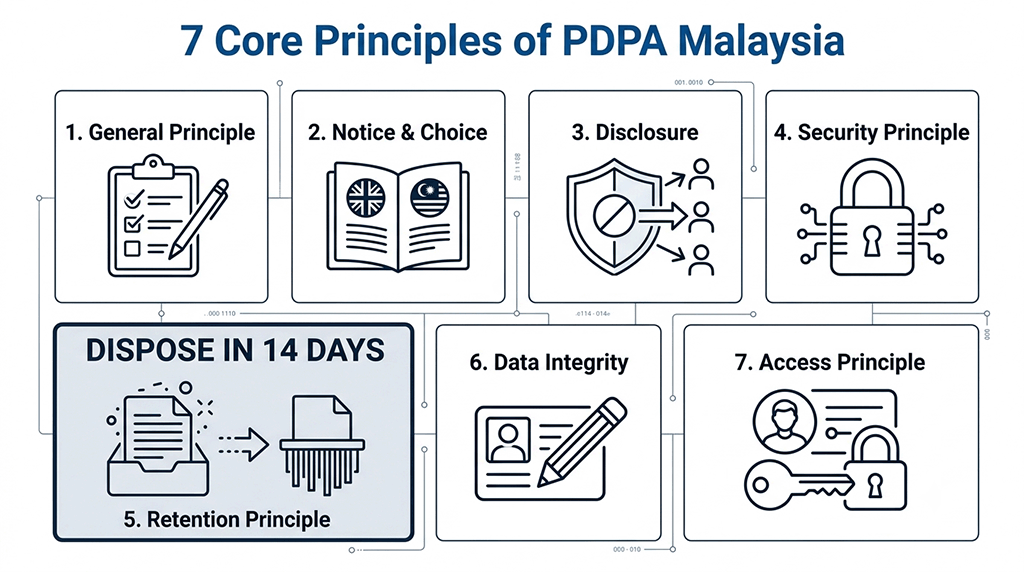
To see how deeply your organization is exposed, review how standard cPanel or generic business email accounts secretly violate the 7 STATUTORY PRINCIPLES every day:
| The 7 Core Principles | What It Legally Requires | Why Standard Email Fails |
|---|---|---|
| 1. General Principle | You cannot process personal data without explicit, recorded consent. | Standard setups lack built-in tools to capture, track, or record data subject consents automatically. |
| 2. Notice & Choice | You must inform users in Malay & English about what data is being tracked and shared. | Generic mail servers offer no automated privacy notice triggers or opt-out options for incoming/outgoing mail. |
| 3. Disclosure | Data cannot be shared with third parties without specific consent. | Traditional email makes it easy for employees to accidentally or intentionally forward customer lists to unauthorized external accounts. |
| 4. Security Principle | You must enforce robust technical security, individual access tracking, and backup recovery systems. | Basic cPanel or unmanaged servers rarely provide tamper-proof individual access logs or automated disaster recovery policies. |
| 5. Retention Principle | Personal data cannot be kept longer than necessary and commercial data must be destroyed within 14 days of full use. | Standard mailboxes store massive archives of old emails indefinitely, creating a massive pile of unmanaged liability. |
| 6. Data Integrity | You must take reasonable steps to ensure data is accurate, complete, and kept up to date. | Legacy email lacks a centralized, secure system where data subjects can easily request to update or correct their profiles. |
| 7. Access Principle | Data subjects must be given the right to access and view what personal data you hold on them. | Finding every piece of a specific customer's data across multiple unindexed, standard employee inboxes is a technical nightmare. |
Rule 3: Enforce Total Data Sovereignty or Advanced Encryption
If your email network is breached or customer data is leaked, you can no longer sweep it under the rug. Data controllers must report any data breach to the Commissioner “as soon as practicable” or face a fine of up to MYR 250,000 and/or up to 2 years in jail.
To satisfy this rule, your email system must deploy one of two distinct, enterprise-grade architectures:
Architecture A: The Automated Gatekeeper (Microsoft 365)
For fast-growing organizations handling high volumes of data, Microsoft 365 acts as an automated security shield:
- Data Loss Prevention (DLP) : M365 allows you to build strict policies that automatically block employees from emailing sensitive customer spreadsheets or NRIC numbers outside the company network.
- Advanced Encryption & Logging : It provides end-to-end message encryption and granular activity logs. If an incident occurs, you can instantly pull up an immutable audit trail to satisfy the mandatory reporting rule “as soon as practicable”.
Architecture B: Total Data Sovereignty (Zimbra Local Cloud)
If your industry is heavily restricted by the strict Cross-Border Transfer rules, Zimbra Local Cloud is your ultimate defense.
- The PDPA broadly restricts transferring personal data outside Malaysia unless the destination country enforces equivalent data protection laws.
- By deploying Cloudhappen’s Zimbra architecture, your emails stay 100% hosted on Malaysian soil, completely bypassing the cross-border data transfer legal trap.
Are You Truly PDPA Ready? Claim Your Free Security Audit
Don’t wait for a devastating breach or a surprise regulatory audit to find out that your current email system exposes you to a RM1 Million fine.
As an expert provider of both local data-sovereign Zimbra cloud systems and highly compliant Microsoft 365 suites, Cloudhappen will help you align your communications platform with the latest regulations flawlessly.
FAQs : What Email System Complies With Malaysia PDPA?
You should use an email platform that fully satisfies the PDPA's core security, retention, and cross-border transfer rules. If total data sovereignty on local soil is your primary requirement, choose Zimbra Local Cloud to keep data within Malaysia. If you require automated prevention tools, choose Microsoft 365 to leverage advanced Data Loss Prevention (DLP) and deep access logging to easily meet the strict mandatory breach reporting benchmarks.
No, using a secure cloud provider does not instantly grant automatic compliance. While platforms like Microsoft 365 provide the highly secure, encrypted infrastructure required under the Security Principle, how your team configures and uses that infrastructure dictates your actual legality. For example, if your employees have no restrictions preventing them from emailing unencrypted customer NRIC databases or matching biometric data to unauthorized third parties, you are still actively violating the PDPA. True compliance requires pairing an enterprise email architecture with tailored Data Loss Prevention (DLP) rules and an enforced email retention and disposal policy.
Absolutely not. Under the latest PDPA framework, your business is classified as the Data Controller. While the updated law now places direct legal obligations on your email host as a Data Processor, the ultimate responsibility for protecting customer data remains with your organization. If a breach occurs due to a weak email architecture, the authorities can penalize both parties concurrently. Furthermore, corporate directors and executives can face personal liability and up to 3 years of imprisonment unless they can prove they performed exhaustive due diligence when selecting and auditing their data storage vendors.

Author
Kim (M365 Specialist)
Meet Kim, Cloudhappen's lead Digital Specialist. She has 15 years of hands-on infrastructure experience. Starting as a certified webmaster, she has successfully managed everything from custom VPS networks to advanced enterprise email security frameworks. Today, she functions as an approachable tech translator for local business owners - listening closely to their challenges & delivering direct, zero-jargon M365 solutions with prompt support.