

An old corporate email solution almost ruined a major international merger
“Ric, where are the signed merger files? The board is sitting in the conference room right now. We have been waiting for an hour.”
Mr. Foong’s voice through the speakerphone was sharp, competing with the heavy Beijing traffic in the background.
Ric looked at his desktop screen, his thumb hovering over his mouse. He knew their current corporate email solution was acting slow lately, but he didn’t expect a total system blackout right now.
“I sent the full 45MB compliance audit package to your inbox at 11:00 AM sharp, Mr. Foong. Check your spam folder?”
“Nothing in spam. Nothing in the inbox. Send it again. Fast.”
Ric clicked resend. Three seconds later, a giant, red error box popped up on his screen:
⚠️ Delivery Status Notification: Message timed out. Connection refused by remote host.
Outside the glass office, his team were staring at their screens. “Inboxes are frozen!” someone yelled from the conveyancing department. “The company website is down too!” called out the receptionist.
A multi-million dollar international merger was on the line, and Ric’s entire office had just gone completely dark because their outdated corporate email solution collapsed.
The Hard Truth First: The Old System Illusion
When Ric first started his law firm, it was just a tight team of 8. His setup was basic. He relied on the free email hosting that came bundled inside his website plan.
Later on, as the client files grew, they migrated over to GSuite. It felt like a solid upgrade. It felt like they were covered.
By the time they entered intense M&A negotiations with Mr. Foong’s mega-firm, Ric’s headcount had scaled to about 18 users. But within just one year of completing the merger, the business boomed, and the team size skyrocketed to over 50+ users.
That is when their choice of a corporate email solution turned into a ticking time bomb.
Most business owners treat their email like a minor administrative detail – just a digital box to pass messages back and forth. But the moment U step into international waters, or the moment your team expands past a certain threshold, relying on an inadequate corporate email solution will baseline your entire expansion.
Here r the two invisible traps that r quietly waiting to choke your business growth.
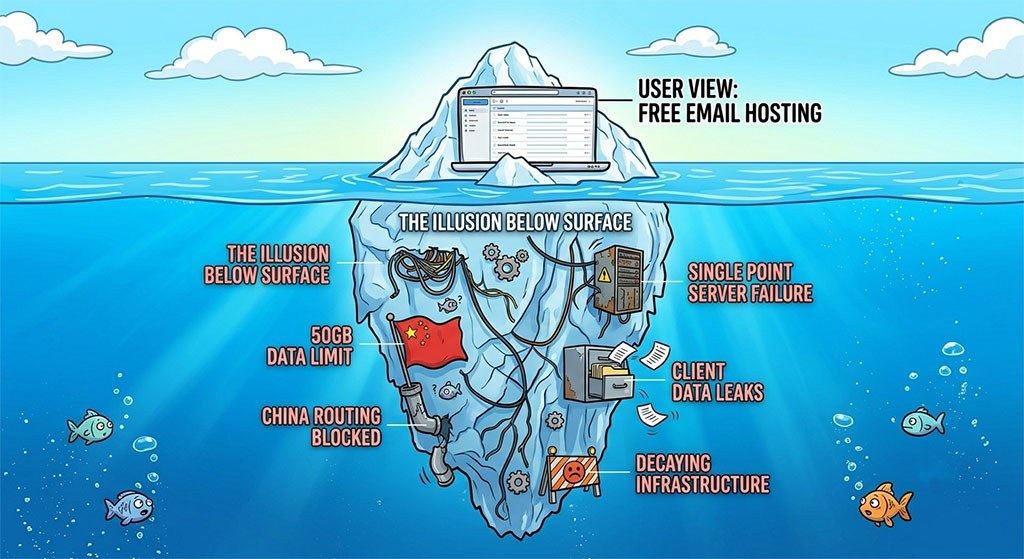
The China Firewall & The 50GB Brick Wall
The first trap is geographical compatibility.
During the critical merger transition phase, Ric’s firm was relying completely on their Google platform. It worked fine for local court cases in KL. But the moment Mr. Foong took over as the principal partner in mainland China, the system snapped.
The Great Firewall of China completely blocks all Google-routed traffic by default. Because Ric’s platform couldn’t handshake natively across borders, their corporate email solution left Mr. Foong completely blind and deaf during the most critical hour of the transaction.
The second trap is the Data Mountain.
A legal team doesn’t just send text; they route massive document trails. Scanned litigation files, heavy evidence folders, and decades of corporate case histories pile up.
Standard, basic email accounts have a strict, unyielding 50GB profile limit.
When Ric’s senior managing partners hit that 50GB wall, their email apps literally refused to receive new messages. To keep them working, their internal IT guy had to resort to a messy workaround: creating two separate email accounts for a single partner just to divide the data overflow.
Ric had to log into ric.partner1@ and ric.partner2@ just to find a single client file from three months ago. It was a clunky, exhausting setup, proving they had outgrown their existing corporate email solution.
The Single Point of Failure (The 2-in-1 Trap)
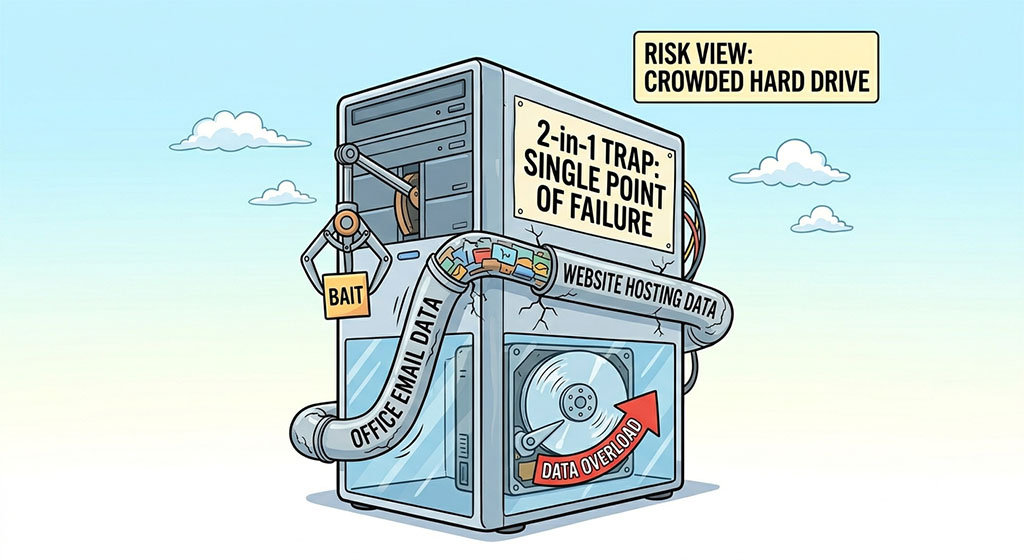
If your business is still using free email hosting layers to run your office, U r sitting on a single point of failure.
In that configuration, your public website files and all your employee email inboxes r jammed onto one single physical hard drive disk inside the hosting server.
Think of it like sharing a tiny, cramped storeroom with your entire staff.
Last Tuesday, a junior clerk in Ric’s litigation team tried to download a giant archive folder of scanned evidence. At the exact same time, three other departments were processing heavy contract briefs. The total data pool hit 100% maximum capacity.
The storeroom was completely full.
Because the drive was clogged, the server didn’t just stop new emails from coming in – it automatically crashed their public website too, throwing up a dirty 500 Internal Server Error page. While Ric was sweating on the phone with Mr. Foong, any new corporate prospect trying to visit their website saw a broken page. Without a segregated corporate email solution, the firm looked like it had shut down overnight to the outside world.
The Modern Upgrade: Smooth, Separate, and Automated
To run a fast-paced, modern enterprise, U have to stop looking at your communications as a cheap utility. It is your primary digital estate.
When Ric finally called us to untangle his architecture and upgrade to a globally compliant cloud platform, his whole operational workflow flipped:
- The 100GB Seamless Inbox: Ric completely threw away his messy dual-account setup. Instead of logging into two separate mailboxes just to read old files, he now uses one single, unified active account that natively handles up to 100GB of active data.
- The Infinite Backend Archive: To stop his local app from freezing under the weight of heavy litigation histories, the system automatically shunts older correspondence into a massive, secure backend cloud archive. Ric doesn’t have to wait or request a manual backup restore—if he needs a contract from three years ago, the system pulls it out instantly right inside his main search bar, while keeping his primary active mailbox perfectly light and fast.
- Global Clearance: Their data now pierces through international network restrictions natively. Ric can fire off a heavy contract file, and Mr. Foong receives it in Beijing under 5 seconds, with zero firewall interference.
- The “Shared Mailbox” Savior: When a staff member leaves the firm, Ric doesn’t delete their account (which deletes all their past case history), and he doesn’t keep paying for an active license. He clicks one button to convert it into a secure, free “Shared Mailbox.” The history is preserved forever, and the incoming successor can read every past message without Ric spending an extra cent.
- True Teams Integration: They traded personal WhatsApp groups – which were leaking sensitive client data and clogging up phone storage – for a secure cloud vault.
In fact, after breaking through that 50GB brick wall, Ric’s firm didn’t just recover, they advanced. Today, all 50+ of their staff members use integrated AI assistants (like Copilot) inside their platform to instantly summarize 200-page legal discovery briefs in seconds, and synchronize international cross-border depositions smoothly via enterprise Teams video channels.
Secure Your Digital Estate with Cloudhappen
If your company is scaling past 20 or 50 users, stop waiting for a server crash or a bounced international deal to tell U that your old system is choking your team.
Let’s take a hard, honest look under the hood of your architecture before it costs U an important contract.
Moral of the Story
For what it's worth, U r not paying for email space, dear. U r paying for an operational insurance policy and an efficiency engine. When U separate your corporate communication from your public web host & give your team a resilient cloud layer, U stop fighting tech fires and start scaling your business with total peace of mind.

Author
Kim (M365 Specialist)
Meet Kim, Cloudhappen's lead Digital Specialist. She has 15 years of hands-on infrastructure experience. Starting as a certified webmaster, she has successfully managed everything from custom VPS networks to advanced enterprise email security frameworks. Today, she functions as an approachable tech translator for local business owners - listening closely to their challenges & delivering direct, zero-jargon M365 solutions with prompt support.